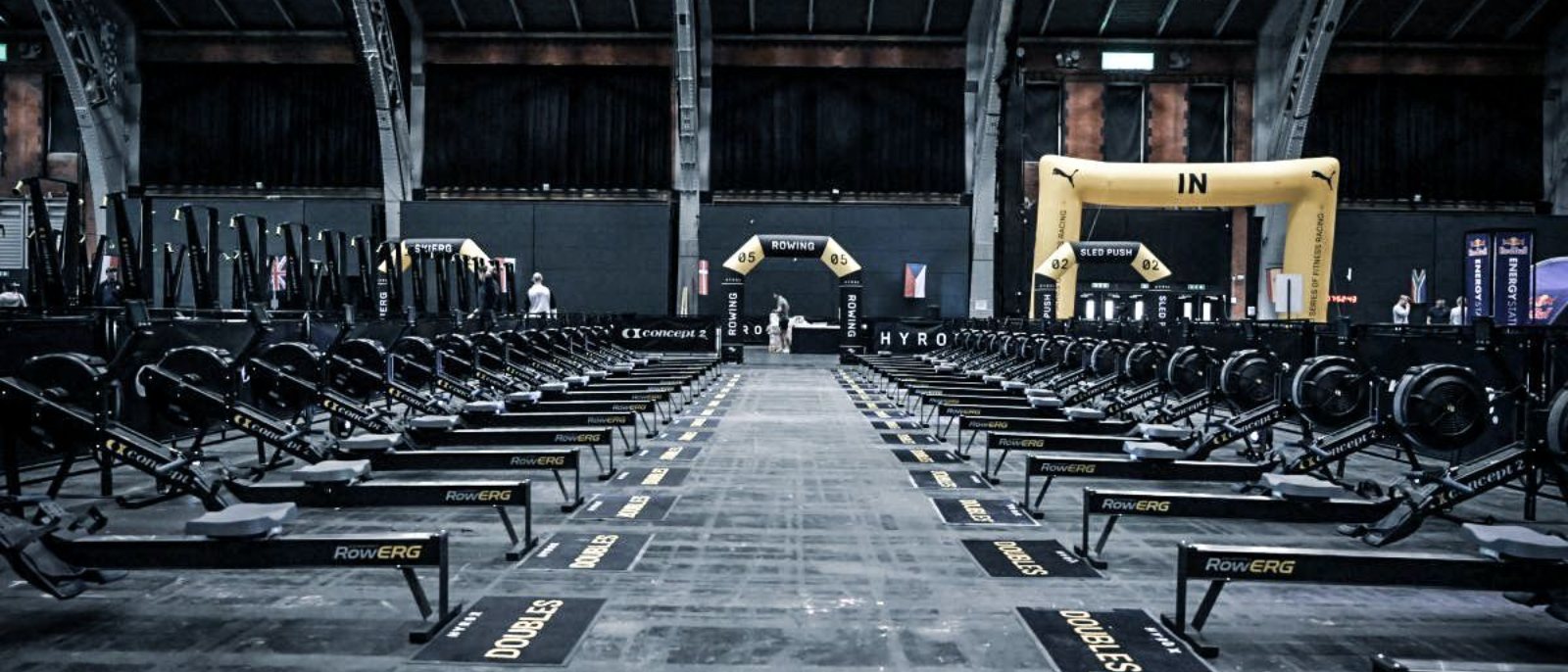
Eight runs, eight stations, one effort you have to spread across roughly an hour. Pacing is the skill that decides whether your fitness shows up on the clock.
Your eight runs are the same distance, so your run splits are the honest record of your race. A well-paced HYROX has splits that are almost flat, with a small, steady drift as the stations pile up. Run one and run eight should be within about 30 to 45 seconds of each other.
A badly paced race looks like a cliff. Runs one through three are quick, run four is fine, and then everything after the sled pull is a minute slower than it should be. Nothing went wrong at station five. The mistake was made in the first ten minutes.
HYROX does not ask how fast you can run a kilometer. It asks what effort you can hold for an hour while your legs are being taken away from you every few minutes. That effort has a ceiling, and once you cross it you cannot get back under it while still moving.
Think of it as a line on your heart rate. Below the line, the stations hurt but you recover on the runs. Above the line, the runs stop being recovery and become more damage. Every pacing decision in the race is about staying under that line as long as possible and only crossing it in the final ten minutes, on purpose.
Most people arrive with one pace in their head, usually their 5k pace, and try to run it. That pace was set with fresh legs. In HYROX you never run with fresh legs after the first kilometer.
Your HYROX run pace should be 30 to 60 seconds per kilometer slower than your stand-alone 5k pace. For most first-timers that feels like jogging. It is the right speed. The stations are where you make your time, and you cannot attack a station you arrive at gasping.
Station pace works the other way: steady, not slow. The goal at every station is to get off it at an effort you can immediately run from. Finishing a station ten seconds faster and then walking the first 100 m of the next run is a net loss.
You cannot guess your race pace. You find it in training, in sessions that look like the race: run, station, run, station, at race loads, with a clock running.
A coach with a clock and a rower will find your number in one session, and tell you when you are lying to yourself about it.
Book A Free Class →Run these slower than you want to. All of them.
You are fresh, the crowd is loud, and everyone around you is going out too hard. This third of the race is where you bank nothing and protect everything. It should feel too easy.
Same pace as the first third. No faster, no slower.
The sled pull, burpee broad jumps and row have taken your legs. Holding the same pace now costs more effort than it did at the start, and that is the point. This is the part of the race you trained for.
Now cross the line. Everything you have left goes here.
If you paced the first two thirds correctly you have something to spend, and there is nowhere to save it for. Run seven hard, empty the tank on run eight, and go into the wall balls with nothing to protect.
Racing the person next to you. They are in a different division, or they went out too hard, or they are a better runner. None of that changes your number.
Trying to make up time after a bad station. A slow sled is gone. Running the next kilometer 20 seconds faster to get it back costs you two minutes over the rest of the race.
Having no plan for breaks. Deciding when to stop on the sled push while you are on the sled push is how a planned 10 second break becomes a 90 second one. Decide it in training, then execute it.
The uncomfortable summary: new athletes can take three to five minutes off their time with pacing alone, without getting any fitter. Slow the opener, hold the middle, spend the end.
That is what pacing alone gives most first-time athletes. Come let a coach read your splits with you.
Book A Free Class →Reading is the easy part. If you want this coached instead of self-directed, Maverick (men) and ATHENA (women) are our online teams — a real roster and a coach who answers you, not a template you follow alone.
You have read how it should be done. This is what it actually looks like written out — a full week of real FTX programming, the same work our members did last week.